
Diabetic control perioperatively

PIG Meeting: 18th March 2021

55 year old male for ACDF for neck and arm pain.

Background

  • Hypertension
  • Type 2 Diabetes Mellitus – recent HbA1c 10.7%. Patient variably compliant with insulin therapy

Issues

  • HbA1c discussed with surgeons. Agreed to defer OT for 3 months to allow optimization. Noted that patient did not have myopathy with urgent indication for surgery.
  • Patient abusive on phone when told. Hung up phone multiple times on nursing and medical staff in clinic.
  • Patient also threatening GP clinic for sharing HbA1c data with Perioperative staff.

Discussion

  • Difficult situation.
  • Patient in denial about significance of chronic disease.
  • Emphasised the importance of decision made in consultation with surgical team. There may be surgical indications to perform surgery in patients not ideally optimized from the diabetic control.
  • The use of a guideline written in consultation with Endocrinologists provides support for clinical decision making.

Plan

  • Discussion with patient liaison officer. Requested their assistance with management of patients complaints and concerns.
Post operative cardiac monitoring

PIG Meeting: 18th March 2021

50s male presents for TURP. Abnormally ECG picked up in the community incidentally by GP prior to this surgery.

Background

  • Fit and well
  • No family history of cardiac disease or sudden cardiac death

Issues

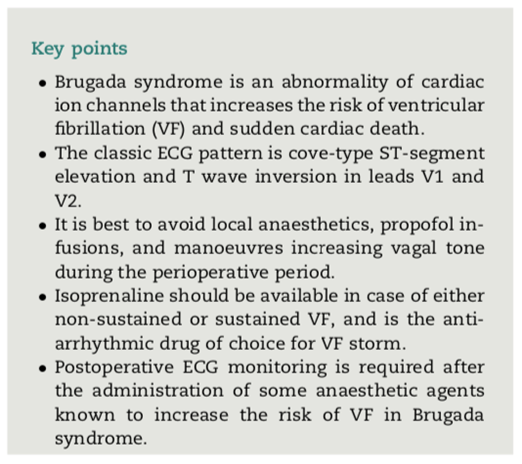
  • ECG demonstrated Brugada type pattern.
  • Patient reviewed by local cardiologist and referred for genetic studies to help quantify long term risk of sudden cardiac death. This will help inform decision regarding managing risk for self and testing for other family members.

Discussion

  • Implications of Brugada syndrome for anaesthesia (see attached paper – summary below)
  • Discussed with patient’s cardiologist – OK to proceed. Recommends post op telemetry

Plan

  • Confirmed need for ECG monitoring post operatively with Cardiologist.
  • Planned for telemetry monitoring on F3 or G3. No indication for ICU monitoring post operatively

IVC Filter

PIG Meeting: 18th March 2021

70s year female presents for resection of floor of mouth SCC and neck dissection + tracheostomy.

Background

  • Hypertension and Asthma
  • Had attempt at same surgery in December 2020. Unfortunately complicated by vascular injury during tracheostomy. This required sternotomy and repair.

Discussion

  • HITTS – diagnosis via HITTS antibody, although low specificity (high false positive rate), with definitive diagnosis with serotonin release assay (usually takes 2 weeks).
  • Absolute contra-indication to heparin and clexane
  • IVC filter – data generally does not support use in perioperative period. May be suitable for patients with high thrombus burden in lower limbs and contra-indications to anticoagulation for extended period. Major issue is failure to remove and loss to follow up. They are difficult to remove once in long period of time due to fibrosis in vessel.
  • See attached European guidelines (summary below)

Plan

  • Patient reviewed by haematologist and discussed with colleagues. Noted that there was an even split on for and against IVC filter preoperatively!
  • Following a discussion between surgeon and haematologist and interventional radiology a decision was made to cease NOAC 72 hours preoperatively and place IVC filter 24 hours preoperatively.
  • Note that heparin was contra-indicated intra-operatively for use during vascular flap resection. Post op plan for fondaparinux for thromboprophylaxis.

Postscript – procedure successful and patient now on ward.

High risk patient, low risk procedure

PIG Meeting: 11th March 2021

34 year old lady for hysteroscopy, endometrial biopsy and mirena

Background

  • Abnormal uterine bleeding for many years. No previous investigations.
  • Super-morbidly obese. BMI 78
  • Severe OSA. AHI 100 with >50% of sleep at saturations less than 85%
  • Admission to ICU in last few years with respiratory failure post-URTI
  • NIDDM. Good glycaemic control.
  • Severe social anxiety.

Issues

  • Declining spinal and/or light sedation. Requesting only GA.
  • Booked as day-only procedure
  • No HDU/ICU beds available. Other elective surgeries being cancelled.
  • Oxygen saturations 86% on room air after moving onto theatre table.
  • Extensive discussion with patient, surgeon, and anaesthetic colleagues about the risk of GA in day stay setting and no availability of HDU support.
  • Decision made to postpone and rebook with ICU bed as patient very unhappy with anything other than GA
  • At this point patient decides she will proceed with spinal.

Discussion

  • Opinion was that patient received a safe anaesthetic in the circumstances
  • Ethics difficult as patient left with little choices on the day
  • No local practice regarding day stay procedures in high BMI and OSA patients. See ANZCA professional document PS15 on Guidance for perioperative management of patients selected for day procedures.
  • consensus was that it would be an unsafe day stay procedure if opioids administered.
  • Many of these minor gynaecological procedures now being done under prilocaine spinal in the private with success (see attached BJA education paper on ambulatory spinal anaesthesia)

Gastroscopy and colonoscopy for Inflammatory bowel disease

PIG Meeting: 11th March 2021

64 year old lady for gastroscopy/colonoscopy and biopsy to exclude IBD

Background

  • Chronic nausea and diarrhoea
  • Super-morbidly obese; BMI 68
  • RA – on infliximab and Methotrexate
  • IDDM – on multiple oral hypoglycaemic agents and 130 units of insulin per day.
  • HbA1c – 7.2
  • SVT – multiple hospital presentations.
  • SVT ablation abandoned on DOS due to increased BMI.
  • Declined for weight-loss surgery

Issues

  • High-risk patient and uncertain indication for procedure.
  • Discussion with proceduralist revealed that it is very unlikely to be IBD but should be excluded given her history of autoimmune disease.
  • Patient was offered faecal calprotectin test but would have to self-fund cost of $70 and cannot afford it.
  • Patient unwilling to engage with weight-loss or dietician services. Limited by finances and RA.
  • Declining optifast due to costs involved. Previous successful weight loss preoperatively with optifast.

Discussion

  • Very unfortunate situation, difficult to build rapport with patient.
  • Poor compliance with optimization strategies makes it very difficult to perform procedures for this high-risk patient.
  • Poor compliance is the most likely reason she was declined for weight-loss surgery.
  • She feels let-down by the medical profession due to multiple cancellations
  • Confusion around the need for gastroscopy. This needs to be clarified with proceduralist

Plan

  • Proceed colonoscopy and biopsy with minimal sedation
  • Further discussion with proceduralist regarding gastroscopy and funding for faecal calprotectin.

http://www.clinicallabs.com. https://www.clinicallabs.com.au/functional-pathology-old/practitioners/functional-tests-arterial/calprotectin-test/au/functional-pathology-old/practitioners/functional-tests-arterial/calprotectin-test

Binder Syndrome Vs Graves’ Disease

PIG Meeting: 11th March 2021

36 year old lady with Binder Syndrome for removal of maxillary plates

Background

  • Binder syndrome – requiring multiple maxillofacial surgeries for nasal hypoplasia
  • Recurrent sinusitis necessitating removal of maxillary plates
  • Severe OSA – AHI 79. Sinusitis making it difficult for patient to comply with CPAP
  • Graves’ Disease – normal TFT’s. Known ‘enlarged thyroid.’ Not requiring management to date.

Issues

  • Recent increase in orthopnoea and hoarse voice
  • ENT referred to endocrine – awaiting review
  • Patient very keen to proceed with ENT surgery as sinusitis is greatly affecting her QoL

Discussion

  • New symptoms likely due to sinusitis and OSA
  • Patient is unable to tolerate CPAP due to sinus discomfort
  • Progression of thyroid disease should be investigated given history

Plan

  • Repeat TFT’s and Thyroid US (if not had recently) and discuss with endocrine surgeon
  • Chase Endocrine review

Thoracotomy and dyspnoea

PIG Meeting: 11th March 2021

83 year old lady with left lower lobe lesion for thoracotomy and wedge resection

Background

  • Incidental finding of LLL lesion on CTPA. Under surveillance for one year, increasing in size. Asymptomatic.
  • Cardiothoracic surgeon strongly suspicious of malignancy
  • Long-standing dyspnoea – previous PE. Investigated but no cause identified. Intermittent in nature.
  • DASI 5 METS
  • Spirometry: reduced FEV1 (63%) DLCO and FVC normal
  • PAF. Normal echo and Holter

Issues

  • Elderly patient without confirmed diagnosis of cancer. Should we proceed or discuss less invasive options with surgical team?
  • Dyspnoea concerning as no identified cause. Excluded significant issues such as valvular heart disease and pulmonary hypertension. Would non-invasive stress test change management – likely need expedited surgery due to cancer possibility.
  • Anticoagulation – high risk for VTE. CHADSVASC = 6

Discussion

  • Thought to be little benefit in delaying to biopsy as surgeon suspicious of cancer. Will likely need to have surgery regardless.
  • Dyspnoea in patients with no respiratory cause and structurally normally heart could be caused by Atrial Fibrillation. Rate well-controlled, no need to increase dose of beta-blocker preoperatively
  • Consensus was to bridge given high risk from CHADSVASC score

Plan

  • Proceed to surgery without further investigations
  • Clexane bridging

Post-operative ICU given age, open procedure, and co-morbidities

Cardiology conflicting advice

PIG Meeting: 11th March 2021

73 year old man for unicompartmental knee replacement

Background

  • Mild OA of knee, restricting ability to play golf
  • Good exercise tolerance. DASI 7 METS
  • IHD – stents in 2000 and 2008. No follow up or symptoms since
  • Type 2 diabetes. Excellent glycaemic control

Issues

  • Positive sestamibi – RCA territory. Report states “test in isolation puts the patient into the moderate to high-risk category for perioperative cardiac event.”
  • Asymptomatic for many years and also during sestamibi.
  • Minimal knee symptoms, limiting golfing only.
  • Discussed at cardiology meeting, Dr Collins recommended cardiology appointment and angiogram
  • Reviewed by different cardiologist at clinic, outcome was to proceed with surgery and have angiogram post-operatively

Discussion

  • Awkward situation!
  • Many valid points raised regarding appropriateness of test in first instance
  • Consensus was to proceed with surgery as clinic cardiologist has reviewed the patient face to face and made an objective clinical assessment.
  • Perioperative troponin – should we consider in this patient? Agreed that this was a valid consideration but not practical as there is no current consensus in JHH on where and how to treat if raised post-operative troponin.

Plan

  • Proceed to surgery
  • Discuss case with procedural anaesthetist
  • Consider BNP. Most agreed that patient has had adequate perioperative risk assessment adding BNP unlikely to change management at JHH.

TURP and Aspirin allergy

PIG Meeting: 11th March 2021

Background

  • On clopidogrel for history of TIA but had no formal diagnosis.
  • Urology team requested to cease clopidogrel and replace with aspirin for perioperative period.
  • Patient states he had previous urticaria and dyspnoea while on aspirin. Surgical team then suggested he commence aspirin and anti-histimine

Discussion

  • Difficult to confirm diagnosis of TIA, no neurologist input
  • No other CVS risk factors and previously ceased clopidogrel for other procedures
  • Aspirin-exacerbated respiratory disease (AERD) and anaphylaxis to salicylates is not uncommon and should be taken seriously.

Plan

  • Consensus that it is prudent to cease clopidogrel and not commence aspirin in this case given the soft indication
  • Surgical commitment to ensuring the patient received adequate antiplatelet cover was noted and commended