
Laparoscopic radical nephrectomy with unoptimised ischaemic heart disease

PIG Meeting: 11th February 2021

57yo male with renal cancer for radical nephrectomy.

Background:

  • BMI high ++
  • T2DM
  • Dyslipidaemia
  • HTN

Issues

  • ? Ischaemic heart disease
    • Exertional chest pain
    • GP arranged a stress ECG – positive
    • Saw cardiologist –  stress ECG again positive and the patient experienced chest pain, but stress echo negative for ischaemia. Discharged from cardiologist’s care.
    • CTCA arranged which showed severe RCA vessel narrowing.
    • Reviewed at cardiology-anaesthetics meeting – suggested angiogram and likely PCI.
    • Discussed with surgeon –
      • Will operate on aspirin but not on clopidogrel
      • Based on tumour imaging suggesting nil capsular invasion, ok to delay surgery 3/12 to enable cardiac stenting and short duration DAPT.

Discussion

  • Why did this patient have so many non-invasive cardiac tests?
    • Usually patients have invasive cardiac testing (angiography) if one non-invasive test is positive, especially in the setting of symptoms.
    • Perhaps due to GP’s strong suspicion that there was underlying IHD.
  • What are the current guidelines around duration of DAPT after PCI?
    • Case-by-case basis, with multiple factors influencing decision (essentially bleeding v. Stent thrombosis)
      • Patient – diabetes, ACS, age, LV function
      • Stent – calibre, overlaps, branching, length, DES v. BMS
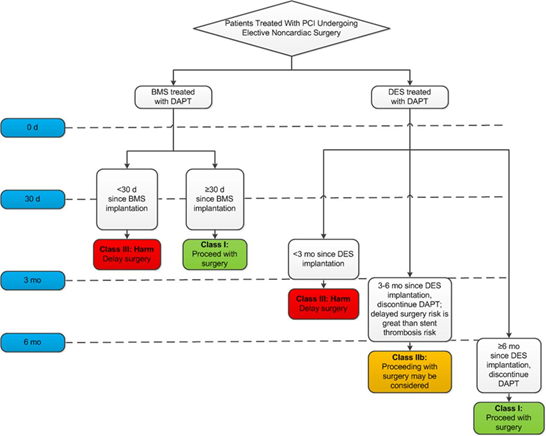
    • AHA guidelines recommend 3 months of dual antiplatelet therapy post drug-eluting stent (See diagram below).
    • Recent database evidence from Denmark suggests risk of MI and cardiac death after DES is elevated only with surgery within the first month after stent placement (See attached paper).
    • All such cases require consultation with the treating cardiologist and surgeon to reach a compromise.

Fructosamine in the perioperative period

PIG Meeting: 11th February 2021

Follow on from recent PIG patient, booked for TKR, with poorly controlled diabetes among her many comorbidities. Qualification sought from surgeons about their accepted preop HbA1c. Surgical team advised that max 7.5% accepted but that fructosamine level may be used if patient is borderline, as a means to either justify or refuse surgery.

Discussion

  • What is fructosamine?
    • Refers to glycosylation of plasma proteins, predominantly albumin.
    • Higher plasma glucose levels lead to increased glycosylation (similar to glycosylation of Hb)
  • What is its significance?
    • Plasma proteins have shorter t1/2 than Hb, so it fructosamine level reflects glucose control over the previous 2-3wks.
  • What does it mean in context of surgery?
    • Limited evidence for HbA1c correlating with postoperative outcomes (and no evidence for 7.5% v. 8.5% cutoff)
    • Evidence exists for improved outcomes with better glucose control in the more immediate perioperative period.
    • 2019 paper showing correlation between higher preop fructosamine levels and higher rates of periprosthetic joint infection, reoperation and readmission. Although significant potential issues about the validity of this trial
  • Should we be targeting fructosamine instead of HbA1c?
    • May be a target in the future but this would require a review of evidence and agreement between the orthopaedic surgeons, periop service and endocrinology service.
  • What are the details of the test itself?
    • At JHH 10-30 of these processed daily
    • Run 24h a day, with a turnaround time similar to a UEC.
    • Cost – Awaiting advice from pathology revenue department.

Elderly Jehovah’s Witness for Total Hip Replacement

PIG Meeting: 11th February 2021

85yo male for THR

Background

  • Mantle cell lymphoma – in remission
  • HTN
  • Mild anaemia Hb 122

Discussion

  • Can his anaemia be optimised?
    • Discussed with haematologist – didn’t feel EPO was indicated
    • Fe replete
  • Should we use cell salvage?
    • Blood transfusion after primary THR is not uncommon (although usually occurs postoperatively)
    • Lymphoma is not a contraindication. See the HNE cell salvage guideline.
    • Info from one of the cell salvage coordinators:
      • “Closed circuits” for JW patients just means than the return bag is connected from the start by an infusion line to the patient.
      • Newer systems have a smaller collection bowl but still need to be filled. The circuit is flushed with saline to collect any red cells stuck in the filter and saline-soaked bloodied packs can also contribute to collection. There is still a minimum volume but this is small with an end-product of 135ml of 70% Hct red cells.
    • Disadvantages include the environmental costs of the circuit + staffing and resource allocation (outweighed by the benefits in a patient who declines allogeneic transfusion)
  • Which surgical cases warrant cell salvage in a JW patient?
    • Difficult to be specific, each case needs to be considered individually.
    • In general, cases which would normally warrant a G&S (and thus have a likely higher risk for transfusion), should likely have cell salvage, although this is not a hard rule and may need to be discussed with the surgeon.

Phone consultations in clinic, missed pre-op optimisation?

PIG Meeting: 4th March 2021

Case one:

64yo male for lap high anterior resection for sigmoid polyp unresectable at colonoscopy.

PHx: HTN, dyslipidaemia, obesity BMI 33, smoker, chronic mild hyponatraemia (thought secondary to alcohol misuse)

On day of surgery:

  • Identified in the bay as high risk for OSA (STOP-BANG 6, body/facial habitus highly suggestive)
  • Conversion to laparotomy after failed initial anastomosis.
  • Pain well controlled with multimodal analgesia (TAP catheters, ketamine intra-op, opioids, COX2i, paracetamol)
  • Extended observation in PARU to ensure sedation/respiratory depression v. Analgesia favourable.
  • Referred to ICU outreach for closer observation overnight.
  • Nil issues arose.

Discussion:

Visual cue of the obese patient may lead to missed identification of patients at risk of OSA.

ICU outreach can provide a valuable tool for patients identified as at increased risk for an adverse perioperative outcome.

Case two:

74yo male for TAMIS resection of rectal polyp.

PHx: HTN, severe vertebrobasilar disease, BMI 34. Atrial ectopy on ECG from 18mths prior.

On day of surgery:

  • Identified at time of positioning for SAB as having irregular pulse and cardiac output on arterial line (arterial line used due to severe cerebrovascular disease)
  • 12 lead ECG difficult to interpret, initial showing ? Atrial ectopy, then a second trace showing atrial flutter with variable block.
  • Electrolytes normal
  • Corridor consultation with two anaesthetists regarding decision to proceed or cancel. Precancerous lesion (i.e. non-urgent surgery) v. Clopidogrel already withheld 7days exposing patient to stroke risk v. Poor usage of theatre time v. Patient expectations v. Already significant delays on the day due to surgical misadventure with previous patient…Decision to proceed.
  • HR dropped to 40 with colonic insufflation with ~5-6 flutter waves before a ventricular complex, BP maintained, ? CHB.
  • Treated with atropine, appeared to respond initially but not with a second episode.
  • Pads placed in case pacing required. Isoprenaline sourced.
  • Discussed with cardiology AT
    • Patient admitted to monitored bed (G3) overnight.
    • Formally diagnosed with atrial flutter.
    • Plan for commencement of Apixaban once surgeons satisfied bleeding risk passed.
    • Discharged home, plan for referral to cardiologist and for TTE, by GP.
  • Could this situation have been avoided with a face-to-face consultation?
    • Physical examination and ECG in clinic would likely have identified the issue
    • ECGs can be requested (e.g. from GP) even with phone consultations in patients who meet the preop criteria.
    • Age > 50 (men), > 60 (women)
    • Cardiac disease as evidenced by history or exam
    • Presence of cardiac risk factors
    • On further questioning, this patent did actually have a history of palpitations and was awaiting investigation by the GP.
  • How should this patient have been worked up prior to non-urgent surgery?
    • Check serum electrolytes
    • TFTs
    • TTE to look for structural heart disease
    • Cardiologist review for rate control, treatment of active precipitating disease processes, anticoagulation and consideration of electrical or pharmacologic cardioversion.

Perioperative warfarin and bridging management

PIG Meeting: 4th March 2021

78yo female for cystoscopy.

Background:

  • AF – warfarinised. Distant TIA (2008)
  • IHD – CABG ’15
  • PPM for CHB
  • CKD
  • T2DM on insulin
  • PVD
  • HTN

Discussion:

  • Does this patient need bridging therapy?
    • This patient would be classed as moderate or high risk using the CHADS2 scoring, depending on the inclusion of her distant TIA as part of the ‘stroke/TIA/systemic emboli’ component.
    • ‘High risk’ (CHADS2 5 or 6) suggests bridging therapy is indicated.
    • With a ‘moderate risk’ (CHADS2 score 3 or 4), the decision to bridge is more at the discretion or the clinician, taking into account risk of surgical bleeding, individual patient factors, and patient preferences.

Note perioptalk.org website updated to standardise with approach on flipcharts in the perioperative clinic for perioperative management of anticoagulants.

Perioperative cochlear implant management

PIG Meeting: 4th March 2021

Case study:

  • 65yo patient for gynae surgery at another institution
  • Patient arrived with a black arm band identifying her as having a cochlear implant and specifying diathermy may not be used.
  • Conflicting advice/understanding from surgeon/nearby ENT surgeon/anaesthetist about what may/may not be used.
  • Damage to the device or surrounding tissues is an extreme adverse outcome for these patients.

Discussion

  •  Summary of various guidelines:
    • No monopolar diathermy for Head and Neck surgery due to risk of damage to the device and surrounding tissue through current induction. Monopoly diathermy use elsewhere in the body necessitates placing the grounding plate distant from the device site, to ensure current flow is not through the device.
    • Bipolar diathermy must be at least 1cm away from the entire Cochlear device.
    • MRI compatibility depends on the device type, time since implantation and MRI machine type/capabilities. All cochlears have an internal magnet. Some devices are MRI compatible, some need the magnet removed first and some are not MRI-compatible. External components usually need to be removed and pressure bandaging of the head may be required. Consultation between MRI staff and cochlear device company must occur. More info at https://www.oticonmedical.com/cochlear-implants/new-to-cochlear-implants/living- with-a-cochlear-implant
    • No ECT
    • Diagnostic and therapeutic US may pose a risk to the device and should not be used over the implant site.
  • Similar issues exist for peripheral nerve stimulators, spinal cord stimulators and deep brain stimulators.
    • In addition the device should be switched off by patient, where possible.
    • Consideration of the disease process for which it was implanted (e.g. PD) and therefore the implications of switching off the device -> consult with the managing clinician.

Update on pregnant patient with mitochondrial degenerative disease

PIG Meeting: 4th March 2021

34yo lady booked for elective CS.

Background

  • Mitochondrial degenerative disorder POLG
    • OSA – Central and peripheral
    • Bulbar dysfunction
    • Ophthalmoplegia
    • Ataxia, pre-pregnancy 2km with FASF, now mostly in wheelchair. Falls
    • Epileptiform EEG
  • Obesity BMI 38
  • Pregnancy:
    • G1PO
    • Pregnancy itself uneventful.
    • Nil genetic testing of partner or foetus (for mitochondrial issues or for CF known to exist in partner’s family)
    • On prophylactic clexane due to immobility
  • Distance patient (Tamworth)

Issues

  • Multidisciplinary involvement needed
    • Cardiology – TTE and Holter monitor required due to symptoms of possible decompensated heart failure, and the risk of cardiomyopathy and dysrhythmias associated with this condition.
    • Neurology – ambulatory EEG required due to recent symptoms possibly due to nocturnal seizures and the risk of refractory, fatal seizures with this condition
    • Resp –  CPAP manlfunctioning
  • Concern that this patient required high level multidisciplinary care which is impossible to access from her distant location. Also mindful of the risk of further decompensation of her medical issues or an obstetric issue necessitating delivery in Tamworth, where the outcome may be poor for both mother and foetus.
  • Suggested to obstetric team that this patient be admitted to enable all reviews and investigations, and then remain an inpatient with ICU level 2 after the delivery.

Elderly patient with severe heart disease for laparoscopic cholecystectomy

PIG Meeting: 4th March 2021

73yo male booked for lap chole due to recurrent choledocholithiasis

Background

  • Choledocholithiasis – several admissions with sepsis requiring IV Abx and ERCPs
  • Cardiac disease
    • Missed STEMI 2019 – DES to LAD, LCx occluded, not amenable to PCI
    • Polymorphic VT arrest 2019 2 days post ERCP, hypokalaemic.
    • 2nd polymorphic VT arrest 2/7 later (K+ normal)
    • AICD placed, nil shocks since.
    • Bisoprolol and amiodarone
  • Paroxysmal AF – on dabigatran
  • GORD
  • Smoker
  • Ex tolerance 5 METS as per DASI

Issues

  • Cardiac status
    • TTE – EF 30-35%, stage I diastolic dysfx, mild MR, mild AR, e/o inferolateral RWMAs, biatrial moderate to severe enlargement.
    • Reviewed by cardiologist – Nil current e/o CCF, exercise tolerance only mildly limited

Discussion

  • Should he have surgery?
    • SORT score 5.4% risk of death
    • Severe cholangitis in this man carries a high risk of morbidity and mortality, as does emergency surgery.
    • While his risk of death with elective surgery is not insignificant it is likely the lower risk option.
  • Opportunities for optimisation?
    • Cardiologist r/v suggests HF reasonably controlled. Suggested ceasing Dabigatran 48h preop and switching to aspirin until resumption of anticoagulation.
  • Postoperative care location
    • >5% risk of perioperative mortality widely considered to represent ‘high risk’ however limited ICU bed spaces necessitates thoughtful rationing of resources.
    • Extended recovery (i.e. 4hr stay) is a useful option – observe for dysrythymias, replenish electrolytes as needed, support normal physiology then, provided no issues arise, discharge to normal ward.