
JW patient for THR

PIG Meeting: 13th May 2021

Male patient 70+ for THR.

Issues:

  • Jehovah’s Witness
    • Initial surgeon declined to operate due to JW status (acceptable ethically as long as the clinical refers the patient to an alternative practitioner)
    • Patient required an advanced care plan which included specifics of blood products. Sent from pre-anaesthetic clinic with advice to speak with his church for assistance.
    • Local JW church declined to be involved due to patient’s lack of ongoing formal involvement with the church.
    • GP declined to advise on ACP due to lack of knowledge in this field.
    • Face-to-face consultation arranged in clinic
      • Full list of available blood products discussed
      • NSW Health ACP used to guide discussion, with additional caveats included regarding blood products.
      • Patient revealed that in case of life-threatening haemorrhage, he certainly WOULD accept life-saving blood products. He still identifies as a JW.

Discussion

  • Church figures may not always be helpful in assisting the patient to make decisions, as they have their own strong beliefs which they will encourage the patient to follow.
  • Even a JW patient who comes prepared to the consultation may be unaware of many available products, may request products which are not available in Australia, and may not understand the consequences (death) of avoiding blood products in critical bleeding.
  • Models at other institutions include an MDT with the patient, haematologist, JW-liaison officer, surgeon and anaesthetist.
  • Current best practice in our clinic is (for surgeries with a material risk of haemorrhage – e.g. those requiring G&S) to review the patient, then encourage them to speak with their church and review all available blood products, then to re-review the patient in clinic/by phone to formally document all of their wishes.
  • Ongoing project in the Peri-operative department regarding blood product documentation for JW patients.
Major orthopaedic surgery post recent PE

PIG Meeting: 13th May 2021

Female patient in her 30s. Ex-athlete with severe hip OA.

Background

  • PE post-partum, approximately 3/12 ago
  • Obesity BMI 42, previous sleeve gastrectomy

Issues:

  • Recent PE
    • Likely precipitated by non-adherence to enoxaparin post-partum (prescribed due to VTE risk)
    • Severe SOB symptoms at the time, now resolved

Discussion

  • ? Appropriateness of surgery timeframe
    • Initially the surgeon/haematologist all on board with plan for surgery 3/12 after PEs
    • Later appeared that perhaps that patient had put significant pressure on clinicians to create these plans
    • Awaiting further respiratory r/v
    • BMJ Best Practice: Anticoags can usually be stopped after 3 months (or 3 to 6 months for people with active cancer) if the PE was provoked, as long as the transient risk factor is no longer present and the clinical course has been uncomplicated. Anticoagulation is usually continued for longer if the PE was unprovoked.
    • The clinician involved in this case uses presence of residual clots on V/Q scanning to guide anticoags.
    • Usually semi-urgent surgery undertaken after 3/12 delay after PE/DVTs, however elective surgery often delayed further to reduce risk as much as possible. Limited evidence to guide a complex clinical situation.

Plan:

  • Surgeon now keen to postpone surgery further. Group consensus is that this is safer for the patient.
  • PIG doctor will update the respiratory physician on progress to ensure all clinicians are informed of the complex events thus far.

Major orthopaedic surgery with metastatic melanoma

PIG Meeting: 13th May 2021

74yo male for THR with multiple comorbidites including metastatic melanoma

Background

  • Melanoma – metastatic
  • Acromegaly – transphenoidal resection, low level biochemical persistence, no further tx planned
  • Cardiac disease – due to acromegaly, HCM and mild PHTN
  • OSA – improved post adenoma resection, daytime somnolence and apnoeas resolved.
  • Obesity BMI 50
  • DASI 4.6 METS, limited by hip pain/function and fatigue
  • Previous difficult spinal (failed attempts), difficult BMV but grade I ETT.

Issues

  • Cardiac disease
    • TTE arranged, very reassuring with nil significant abnormalities.
    • ECG consistent with changes due to HTN/BMI/acromegaly
    • Reviewed at cardiology-anaesthetics meeting. Ok to proceed with nil further imaging/review
  • Melanoma/life expectancy
    • Oncologist says pt a candidate for last-line immunomodulatory melanoma tx but will commence this after THR.
    • If tx successful, patient may have years to live, if not then possibly only months.

Discussion

  • Should surgery proceed?
    • Severe hip dx, affecting QoL ++
    • Life expectancy may be dramatically improved by new therapy.
    • Nil specific medical contraindications to surgery.
    • Nil imminently life-threatening conditions, so if this man presented with a hip fracture, surgery would proceed. Given the severe pain/disability at present, perhaps could consider in the same way, as “palliative surgery”.
    • Patient has had a previous THR (other side) in 2017, so is understanding of the rehab requirements and time spent away from family.
    • Group consensus was to proceed with surgery

Elderly, poor function for redo neck surgery

PIG Meeting: 13th May 2021

A 73yo female who had a C5/6 foraminotomy in 2015, and then a revision, now for 3rd surgery to same site.

Background

  • Obesity BMI 48
  • HTN
  • NIDDM
  • PE 2017
  • CKD eGFR 45
  • IHD – MI 2001 -> CABG. Angio 2015 – moderate prox LAD dx, grafts patent. Admitted 2018 with stable angina and ED presentation 2020 -> discharged home after -ve trop and ECGs.
  • On salbutamol – patient unaware of indication
  • Distant ex-smoker

Issues

  • Likely OSA – STOPBANG 6-7
  • Severe SOBOE and weekly exertional angina (relieved by GTN)
    • Lost to F/U from cardiologist
    • ? Needs TTE/cardiologist review/stress imaging
    • Nil pedal oedema, orthopnoea, PND

Discussion

  • Should consider further investigation of OSA risk. Note that potential significant waitlist for elective patients.
  • Discussed at cardiology-anaesthetics meeting
    • Reassured by previous angio images pre- and post-bypass
    • Patient able to climb 20 steps up/down without stopping (SOB ++) so felt that low likelihood of significant lesion requiring revascularisation pre-surgery
    • Nil TTE or stress imaging recommended.
  • PFTs indicated?
    • Severe obesity + deconditioning likely causative for SOB
    • PFTs would likely show a restrictive pattern and mildly reduced diffusion
    • Distant ex-smoker, nil resp exacerbations, nil other clear risk factors for severe, modifiable lung disease
  • Low risk surgery in a high risk patient. ? yield from redo, redo surgery.

Total Knee Replacement and untreated IHD

PIG Meeting: 29th April 2021

60-year-old man for TKR

Background

  • Severe Rheumatoid arthritis, neck subluxation – stable on Humira
  • Dasi 3.6 METs. No exertional symptoms
  • CVA- on DAPT. Residual hemianopia, ataxia, and seizures
  • Aortic root dilatation – stable on TTE no intervention required at present.

Issues

1. IHD

  • RMWA noted on previous TTE, nil hx of IHD
  • Unable to exert himself due to physical limitations
  • Sestamibi showed a large LAD territory perfusion defect
  • Discussed at cardiology-anaesthetics meeting -> angio
  • Angio – occluded LAD, filling via collaterals, not amenable to PCI and therefore no strategies to reduce his perioperative M&M risks.
  • Cardiologist’s letter suggests PCI may be required in the future if he develops exertional symptoms post TKR.

2. Should surgery proceed?

  • Risk of MACE 6.6% (moderate).
  • SORT score <1% risk of death, NSQIP 5.5% serious complication
  • Risks of poor wound healing or infection with immunosuppression, or flair of RA with known severe disease may not be captured by these scoring systems.
  • Main complaint is pain, mobility is already severely limited by RA
  • Noted that the rate of persistent knee pain after TKR is not insignificant
  • Given significant perioperative risks, proceeding with TKR needs careful consideration.
  • Geniculate nerve block is a possibility if main issue is pain (rather than function)

3. Postoperative location if OT proceeds?

Extended period in recovery to ensure excellent pain relief, electrolytes normal and Hb adequate, as this man is at high risk of demand ischaemia.

Plan:

  • For discussion with patient and surgical team re. definitive analgesic options ?geniculate neurolysis

Cystoscopy

PIG Meeting: 29th April 2021

53-year-old lady for cystoscopy and intravesical botox for urge incontinence

  • BMI 48
  • COPD. Current smoker. 40 pack years
  • PFTs showed normal lung volumes but reduced TLCO (likely in keeping with her known pulmonary hypertension)
  • NIDDM. Poor glycaemic control. HbA1c = 9.9%
  • HFpEF and moderate pulmonary hypertension
  • Uncontrolled hypertension
  • Non-obstructive CAD
  • T-cell lymphoma – currently in remission since chemotherapy and stem-cell harvest but moderate prognosis disease with 43% 5-year mortality rate
  • Extremely poor exercise tolerance, resting every 10-20 steps
  • NASH

Issues

  • Consult in clinic and advised on multiple areas for optimisiation including.
    • Weight loss and dietician via GP
    • Smoking cessation
    • Diabetes optimisation
    • Sleep studies
  • Patient had pursued none of these recommendations, citing social stressors.
  • Surgeon contacted to request a further 3mth delay.
  • Surgeon decided to cancel the procedure, believing conservative measures were more appropriate and that her other health problems were far more important to optimise.

Discussion

Was this the right decision?

  • Should we be more compassionate regarding the contribution of her social stressors to her health inertia?
    • Is an incontinence procedure likely to be effective in a morbidly obese smoker? Thought to be low value healthcare.
    • Could this procedure be done under LA (group consensus was no, based on previous experience).
    • Is this paternalistic?
    • Possible that the surgical team requested a ‘consult’ in the hopes that we would say no?
  • Ideally the decision to cancel should have been communicated by the surgical team, rather than via periop clinic.
  • A letter was sent to the GP which clearly outlines ownership of the decision.

Hip replacement for lytic acetabular lesion

PIG Meeting: 29th April 2021

57-year-old man with metastatic intraductal parotid cancer for Prophylactic THR

Background

  • WLE + parotidectomy + temporal bone/mastoid tip resection/neck dissection
  • Adjuvant concurrent chemo/radiotherapy
  • Multiple post-operative and post-radiotherapy lesions including facial drop and poor mouth opening.
  • current smoker

Issues

  • New cerebellar and temporal lobe lesions
  • No neurological symptoms
  • Awaiting neurosurgical review, unlikely to occur pre operatively
  • Multiple bony lytic lesions including acetabulum and ischial tuberosity
  • Uncertain if having acetabular component to surgery
  • Potential difficult airway

Discussion

1. Anaesthetic plan

  • GA vs Spinal discussed
  • Concern expressed regarding spinal placement with large and expanding cerebellar lesions
  • Radiotherapy to face and jaw, airway may be challenging
  • Surgery sounds like it could be complex and lengthy, likely in lateral position
  • GA and secure airway would be preferred plan

2. Neurosurgical review

  • Asymptomatic
  • Large lesions, increased in size between scans
  • Consensus Neurosurgical team should review scans and/or patient preoperatively

Plan

  • Neurosurgical review preoperatively – has occurred – aim to proceed to THR for tissue diagnosis of metastatic disease.
  • Clarify with surgeon regarding surgical procedure
  • Plan for GA and potential difficult airway

PEG Tube insertion in Cystic Fibrosis Patient

PIG Meeting: 29th April 2021

22-year-old for a PEG tube insertion to supplement nutrition

Background

  • CF, end-stage disease
  • Lung transplant 2019. Complex post-operative period requiring ECMO
  • Lung rejection late 2020
  • Recent decision not to proceed to further lung transplant due to disease severity
  • NYHA class 4 dyspnoea, wheelchair bound. 24-hour oxygen. BiPAP for sleeping
  • Pancreatic insufficiency. IDDM
  • Protein C deficiency – bilateral DVT’s and SVC thrombosis. Anticoagulated with warfarin
  • Nutritional deficit, increased metabolic demand unable to be met due to dyspnoea and general exhaustion

Issues

  • CF team and patient requesting PEG to aid in nutrition and improve QoL
  • Patient extremely high risk for GA or even sedation
  • Would not be able to use BiPAP due to need for endoscopy
  • Already ceased warfarin on review at perioperative clinic
  • Very challenging case in a remote location

Discussion

1. Anaesthetic options

  • Local with minimal or no sedation. Use of high flow nasal prongs/THRIVE.
  • Is an open procedure an option? Would negate need for endoscopy and allow use of BiPAP
  • Patient engaged and keen to try under LA

2. Location of procedure

  • Procedural anaesthetist keen to move to theatre 10
  • Proceduralist prefers endoscopy
  • Difficult situation as endoscopy very remote but procedure likely to happen more efficiently there
  • Possible to organise additional anaesthetist support in endoscopy for this case

3. End of life discussion

  • Recent decision (less than a week ago) that lung transplant won’t be proceeding
  • Patient and her mother understand now that her life is very limited
  • No formal documentation of ceiling of care
  • Discussion with CF specialist, has an appointment the day after the procedure
  • Discussion with patient regarding limitations with anaesthesia care and unsuitability for ICU. Understands same and keen to try and have procedure with as little intervention as possible

Plan

  • Investigate possibility of open or radiologically guided procedure
  • Liaise further with CF team regarding end of life wishes. She has been cared for them for many years and it is a discussion that would be better performed by them.
  • Liaise with DA of day to allocate extra anaesthetist if procedure is in endoscopy suite

High risk PCI with Impella Device

PIG Meeting: 29th April 2021

74-year-old man for PCI to left main coronary artery prior to vascular surgery

Background

  • Intermittent claudication at 100m
  • Thrombosed popliteal artery aneurysm, requiring stent
  • CABG 22 years ago
  • Previous LAD stent, now totally occluded
  • Open AAA repair 5 years ago, uneventful
  • Lives independently on acreage. Active, Chops wood.

Issues

  • Elective review by vascular surgeon revealed exertional dyspnoea
  • Sestamibi organised by surgical team showed a significant area of reversible ischaemia
  • Cardiologist review, proceeded to angiogram
  • Previous LAD stent, now totally occluded. All coronary grafts blocked. Native vessels severely blocked.
  • If requires PCI it would be High risk– Left-main and LAD disease. Likely need rotablade with significant chance of impaired coronary perfusion and myocardial stunning.
  • LVEF = 25%
  • Cardiologist advised that if PCI is performed preoperatively, an Impella device would be required

Discussion

Indication for stress test?

  • AHA guidelines would indicate that no myocardial stress imaging is indicated
  • Patient can perform > 4mets and is relatively asymptomatic
  • Cardiologist opinion that medical management is appropriate given lack of symptomatology
  • PCI is requirement for further anaesthesia and vascular surgery
  • Vascular symptoms are limiting exercise tolerance

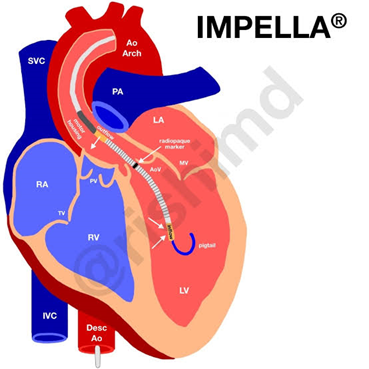
What is an Impella device and why is it used?

  • Impella is a centrifugal pump which acts as Left ventricular assist device
  • The device pumps blood from the LV into the ascending aorta at an upper rate of 2.5L/min
  • Percutaneously inserted via 14fr sheath into the femoral artery
  • Multiple indications including high risk PCI. See www.impella.com and Protect II trial.

Plan

  • Continue to present novel cases such as this to aid in dissemination of knowledge
  • Consider presentation at CME
  • Note vascular surgical patients have baseline higher risk of significant coronary artery disease